Roadside Assistance East Orange, NJ: What to Know About Car Battery Replacement
A vehicle that refuses to start can leave a driver wondering whether the problem is a weak battery, a faulty connection, or something more serious. The situation becomes even more stressful when the car is parked away from home and there is no convenient way to test the problem.
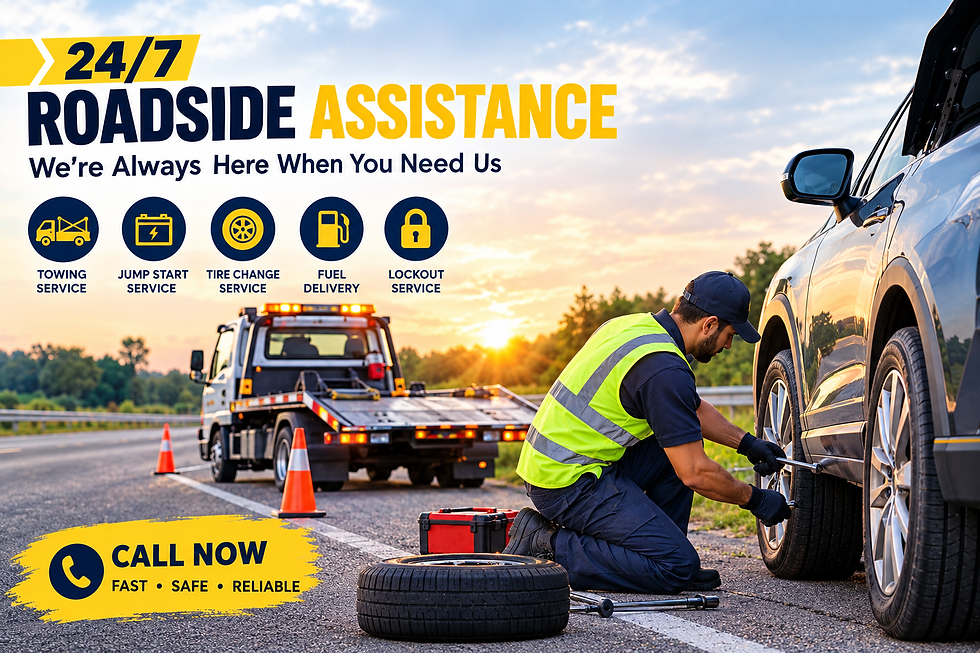
For drivers seeking Roadside Assistance East Orange, NJ, knowing how to recognize battery-related problems can make the next decision much easier. A jump-start may be enough in some situations, while an aging or damaged battery may need to be replaced. In other cases, the battery may only be a symptom of a larger electrical or starting-system issue.
The key is to avoid treating every no-start situation as a simple battery replacement.
How Can You Tell If the Battery Is the Problem?
The behavior of the vehicle can provide useful clues. A battery with insufficient power may cause the engine to crank slowly, produce repeated clicking sounds, or fail to crank altogether.
Other possible signs include:
Headlights or interior lights that appear unusually weak
Electrical accessories losing power
Difficulty starting after the vehicle has been parked
Repeated need for jump-starts
Battery-related warning indicators
Electrical systems behaving differently than usual
These symptoms can point toward a battery problem, but they are not a complete diagnosis. A weak connection, starter issue, charging-system fault, or another electrical problem can create similar symptoms.
That is why the next step should depend on the circumstances rather than the assumption that the battery is automatically at fault.
What Should You Do When Your Car Will Not Start?
First, consider the vehicle's location.
If the car is safely parked in a driveway, parking area, or other protected location, you have more time to assess the symptoms. If it is stopped near moving traffic, safety takes priority over troubleshooting.
Once you are in a safe position, observe what happens when you attempt to start the vehicle:
Does the engine crank normally?
Does it crank slowly?
Do you hear clicking?
Do the dashboard and interior lights work?
Does the vehicle remain completely unresponsive?
These details are useful when explaining the problem to a roadside provider or automotive professional.
Avoid repeatedly attempting to start a vehicle when it is clearly not responding. Repeated attempts may further discharge an already weak battery without solving the underlying issue.
Can a Jump-Start Solve the Problem?
A jump-start can restore enough electrical power to start a vehicle when the battery is discharged and the rest of the starting system is functioning properly.
However, a jump-start does not automatically mean the battery is healthy.
For example, a battery may lose its charge because an electrical accessory was left operating while the vehicle was parked. In that situation, the battery may still be serviceable. On the other hand, an aging or damaged battery may accept enough temporary power to start the engine but later fail again.
The difference matters because the appropriate next step could be continued use, battery testing, replacement, or further diagnosis.
When Should a Car Battery Be Replaced?
Replacement becomes relevant when the battery can no longer reliably provide the power required by the vehicle.
Possible reasons for replacement include:
The battery repeatedly fails to start the vehicle.
Testing indicates that the battery is no longer performing adequately.
The battery has physical damage.
The vehicle repeatedly requires jump-starts.
The battery cannot retain an adequate charge.
The battery is no longer suitable for the vehicle's requirements.
Battery life varies based on the vehicle, battery type, operating conditions, maintenance, and other factors. There is no single replacement interval that applies equally to every vehicle.
A proper battery check is therefore more useful than replacing a battery based only on its age.
When Is Car Battery Replacement the Practical Option?
If the battery has been confirmed as the source of the starting problem and the vehicle cannot be driven to a repair facility, mobile service may be a practical solution.
This is where Car Battery Replacement East Orange, NJ can be relevant for a driver who needs the battery addressed at the vehicle's current location.
The exact replacement battery must match the vehicle's requirements. Size, terminal arrangement, electrical specifications, and battery technology can differ between vehicles. Some modern vehicles also require additional procedures after battery replacement.
For that reason, drivers should avoid selecting a replacement solely because it physically fits inside the vehicle.
What If the New Battery Does Not Solve the Problem?
A replacement battery cannot correct every type of starting problem.
If the vehicle still refuses to start after a suitable battery has been installed, other components may need attention. Possible areas include the starter, charging system, electrical connections, or another vehicle circuit.
This is an important distinction for drivers who assume that a dead battery is always the root cause. Sometimes the battery is discharged because another component is not operating correctly.
A repeated no-start condition should therefore be investigated rather than solved through repeated battery replacements.
What Do Drivers Often Overlook?
Battery problems can have less obvious causes. A few details are easy to miss during a stressful roadside situation.
The Vehicle May Have a Charging Problem
A battery can lose power while the vehicle is being driven if the charging system is not maintaining the expected electrical supply. In that situation, replacing the battery alone may not address the reason it keeps becoming discharged.
Electrical Connections Matter
Battery terminals and connections need to provide a reliable electrical path. Corrosion, looseness, or damage can interfere with starting performance.
Because electrical systems can be sensitive and roadside conditions may be unsafe, unfamiliar drivers should avoid improvised repairs.
A Jump-Start Can Hide a Recurring Problem
If a vehicle repeatedly needs a boost, the goal should be to identify why. Continuing to jump-start the vehicle without determining the cause can leave the driver stranded again.
Battery Location Is Not Always Obvious
Some vehicles place the battery in locations that are different from what a driver might expect. Before attempting service, it is useful to consult the vehicle's documentation or obtain professional assistance.
Is It Safe to Replace a Battery Beside the Road?
The answer depends heavily on the location and vehicle.
A battery replacement may involve electrical connections, lifting or accessing components, and working around other parts of the vehicle. A narrow roadside shoulder or area with fast-moving traffic is not an appropriate place for unnecessary repairs.
Professional assistance is particularly sensible when:
The vehicle is close to moving traffic.
Visibility is poor.
Weather conditions make roadside work difficult.
The battery area is difficult to access.
The vehicle uses a specialized electrical system.
You are uncertain about the correct replacement procedure.
The battery appears damaged.
If the vehicle presents an immediate hazard to traffic or people, contact the appropriate emergency service rather than attempting repairs.
What Information Should You Have Ready?
When requesting roadside help, providing accurate vehicle information can make the situation easier to assess.
Useful details include:
Vehicle make and model
Model year
Exact or nearby location
Whether the engine cranks
Sounds heard when attempting to start
Whether the lights and dashboard work
Whether the vehicle has previously required a jump-start
Any warning lights that appeared before the problem
If you know the battery has recently been replaced or the vehicle has had electrical problems, mention that as well.
How Can You Reduce the Risk of a Battery Emergency?
Preventive attention can help identify a developing problem before the vehicle becomes completely disabled.
Watch for changes such as slower starting, recurring electrical issues, or other unusual behavior. Follow the vehicle manufacturer's maintenance recommendations and address repeated starting problems instead of relying on temporary jump-starts.
It is also useful to keep roadside assistance information accessible and maintain a charged phone, particularly when driving longer distances.
Drivers should never assume that a vehicle will provide plenty of warning before a battery-related failure. Preparation is most valuable before the problem occurs.
A Practical Decision Path for a No-Start Vehicle
When your vehicle will not start, consider these questions in order:
Is the vehicle in a safe location?If not, focus on getting occupants to a safer position and obtaining appropriate assistance.
What happens when you try to start it?Listen for clicking, slow cranking, or complete silence and check whether the electrical systems have power.
Has the vehicle experienced similar problems recently?Repeated incidents may indicate that something more than a temporary discharge is involved.
Could a jump-start be appropriate?A professional can determine whether this is a reasonable next step based on the vehicle and circumstances.
Does the battery require replacement?If testing or diagnosis indicates that the battery is no longer serviceable, replacement may be appropriate.
Does another problem remain?If the vehicle still does not operate correctly after battery service, further diagnosis may be necessary.
This approach prevents the common mistake of treating every starting problem as a battery-only issue.
Frequently Asked Questions
How do I know if my car needs a new battery?
A vehicle that repeatedly struggles to start or has a battery that fails testing may need replacement. Similar symptoms can also come from the starter, charging system, or electrical connections.
Can roadside assistance install a replacement battery?
Availability depends on the provider and vehicle. Some roadside services offer mobile battery replacement, while others may provide a jump-start or arrange additional assistance.
Why does my new battery keep losing power?
A new battery can still become discharged if there is an electrical drain, charging-system problem, poor connection, or another underlying issue. Repeated discharge should be diagnosed rather than solved by repeatedly replacing batteries.
Should I replace a battery myself?
A battery replacement may be straightforward on some vehicles but more complicated on others. If you are unfamiliar with the vehicle's electrical system or the vehicle is in an unsafe location, professional assistance is the safer option.
What should I do if my car dies in traffic?
Prioritize personal safety and avoid standing in active traffic. Use hazard lights when appropriate, move to a safe position if possible, and request suitable roadside or emergency assistance based on the situation.
The Right Battery Decision Starts With the Cause
A vehicle that will not start does not always need a new battery. The most useful first step is to understand the symptoms and determine whether the battery is actually responsible.
For East Orange drivers, roadside assistance can provide a practical option when a vehicle cannot be started safely or when the source of the problem is unclear. If the battery is confirmed to be the issue, replacement may restore reliable starting; if another component is responsible, additional diagnosis may be necessary.
The best approach is simple: secure the vehicle, identify the symptoms, avoid unsafe roadside work, and address the underlying problem rather than only the immediate symptom.



Comments